Diner Table Edges Explained: Ribbed Aluminum, Chrome, Stainless and Wood
How classic diner table edges are made and which to choose: ribbed aluminum T-mold, chrome and stainless bands, wrapped wood and self-edge, plus laminate tops and bases.
Short answer
The classic 1950s diner table is a high-pressure laminate (HPL) top with a ribbed aluminum edge, a metal T-mold whose barbed spine is pressed into a slot cut around the edge of the top. Today you can choose that original ribbed aluminum, a smooth polished stainless or chrome-plated band, a wrapped hardwood edge, or a self-edge in matching laminate. For busy diners, metal edges take knocks best; wood edges look warmer and can be refinished.
Diner Booth Co. (a line by EASEN Commercial Furniture) builds diner tables with any of these edges. This guide explains how each is made and where it works.
Why does the edge matter so much on a diner table?
The edge is the part of a table that gets hit. Chairs knock it, trays and plates are slid across it, booth guests grab it to pull themselves in, and cleaning cloths catch on it hundreds of times a day. A poor edge chips, lifts or lets water into the core, and once water reaches a particleboard core the top swells and the laminate starts to peel.
A good diner edge does three jobs: it protects the laminate's exposed corner, it seals the core, and it gives the table its look.
What edge options are there?
| Edge | How it is made | Look | Durability | Repair |
|---|---|---|---|---|
| Ribbed aluminum T-mold | Extruded aluminum profile with a barbed spine tapped into a kerf (slot) in the top's edge | Authentic 1950s diner | Very good; resists chips | Damaged lengths can be replaced |
| Smooth stainless band | Stainless strip fixed or bonded to the edge | Clean, modern-retro | Excellent | Scratches can be brushed out on brushed finishes |
| Chrome-plated band | Steel or brass strip with decorative chrome plating | Mirror-bright | Good; plating can wear through on high-contact corners over time | Replating or replacement |
| Vinyl T-mold (chrome-look) | Flexible PVC profile in a metallic finish, same kerf fixing | Budget chrome look | Fair; can scuff and discolor | Easy to replace |
| Wrapped hardwood edge | Solid wood band glued around the top, profiled and lacquered | Warm, mid-century | Good; dents rather than chips | Can be sanded and refinished |
| Self-edge | Strips of the same laminate bonded to the edge | Seamless color | Fair; corners can chip | Hard to repair invisibly |
"Chrome" is used loosely in the trade. Ask whether a quoted edge is chrome-plated metal, stainless steel, aluminum or metallic PVC; they look similar on day one and very different after a few years.
How is a ribbed aluminum edge made?
The classic diner edge is a T-mold:
- The top's core (plywood or a moisture-resistant board) is cut to size and laminated on its face.
- A narrow slot, called a kerf, is cut all the way around the edge with a slot cutter.
- The ribbed aluminum profile, which has a barbed "T" spine on its back, is tapped into the kerf with a rubber mallet, starting at one point and working around.
- Corners are either radiused, so the profile bends around them, or notched and mitred on square tops.
- The ends meet at a joint, usually placed at the back or a less visible side.
Radiused corners are kinder to hips and easier for the profile to wrap. On rectangular booth tables we recommend a corner radius of at least 1-2 in (25-50 mm).
Which top surfaces go with which edge?
| Top surface | Typical thickness | Best edges | Notes |
|---|---|---|---|
| HPL on board, horizontal grade | Laminate about 0.048 in (1.2 mm), NEMA LD 3 horizontal general purpose grade | Ribbed aluminum, stainless, vinyl T-mold, self-edge | The authentic diner build; huge range of colors and patterns |
| Compact laminate | 0.47 in (12 mm) solid | Exposed edge or metal band | Very tough, water-resistant |
| Sintered stone or porcelain | 0.24-0.47 in (6-12 mm) on backer | Wrapped wood, metal band | Marble look without marble's staining |
| Wood veneer | On engineered core | Wrapped hardwood | Mid-century coffee shop look |
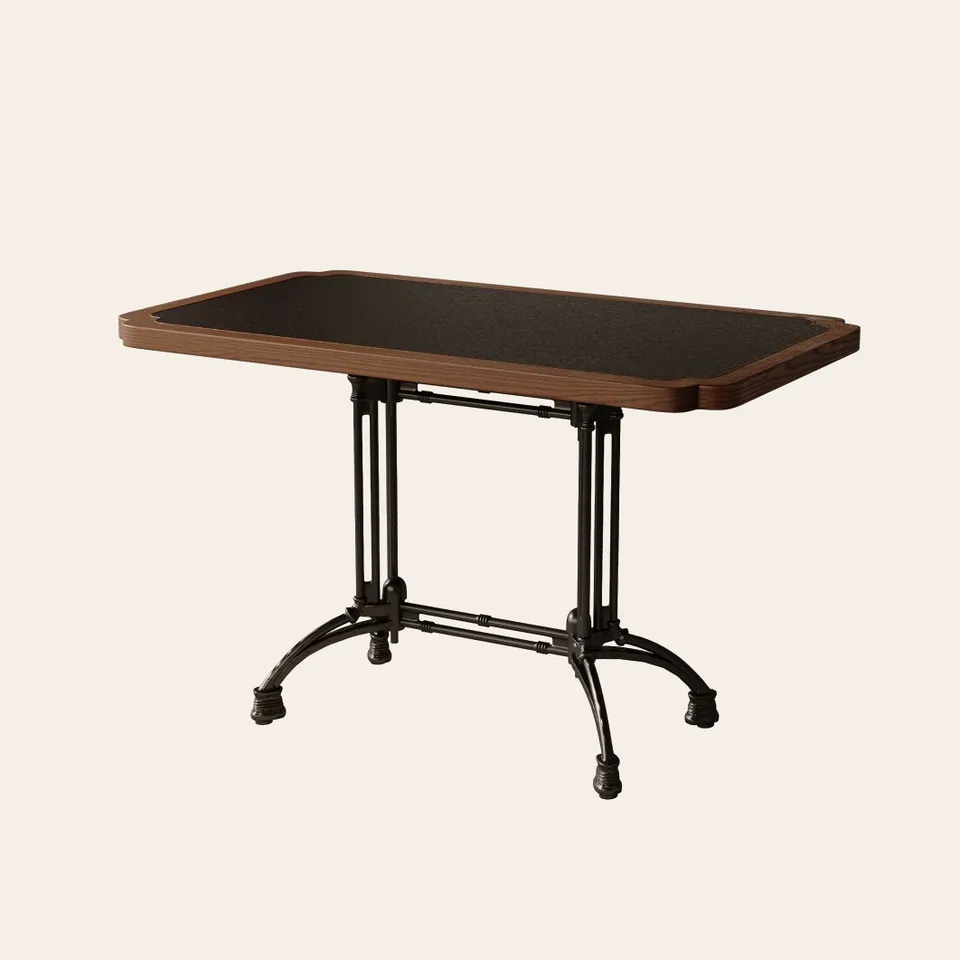
The tables we show, for example the Soda Fountain Four-Top, use a marble-look face with a wrapped wood edge; any of them can be built with a ribbed aluminum or stainless edge instead.
Which laminate patterns look authentic?
The 1950s and 60s diner palette included boomerang and abstract "atomic" patterns, sparkle and cracked-ice effects, solid pastels and red, and marble looks. Several laminate makers still produce, or have reissued, patterns in this spirit. Choose a horizontal-grade laminate for tabletops; vertical grades are thinner and meant for walls and cabinet sides.
What about table bases?
Diner tables almost always stand on pedestals, because guests slide in from booths.
| Table | Base | Foot size |
|---|---|---|
| 24 x 30 in two-top | Single column | 17-18 in (43-46 cm) cross or disc |
| 30 x 30 to 36 x 36 in square | Single column | 22 in (56 cm) |
| 30 x 48 in booth four-top | Twin column or T-base | 22-30 in long foot |
| 36-42 in round | Single column, heavy disc or cross | 22-28 in (56-71 cm) |
Classic diners used chrome-plated columns with stamped or cast bases; today powder-coated black steel is more common, with chrome or stainless as an option. Levelers are essential on old diner floors.
How do you keep metal edges looking new?
Metal edges are low-maintenance, not no-maintenance.
- Wipe with the tabletop. Mild soap and water on a soft cloth; dry it so mineral spots do not build up in the ribs of an aluminum profile.
- Mind the cleaners. Chlorine-based sanitizers left to dry can pit aluminum and dull chrome over time. Rinse after sanitizing, and use products approved for the metal.
- Use the right polish. A non-abrasive metal polish now and then restores chrome and polished stainless. Never use scouring pads on chrome; they cut through the plating.
- Check the joint. The meeting point of a T-mold is the weak spot. If it starts to lift, tap it back before a cloth snags it and pulls more of the profile out.
- Keep spare profile. Order a few extra feet of edge with the tables so damaged lengths can be swapped years later in the same finish.
Checklist: specifying a diner table
- Top size and shape for each bay
- Top surface: HPL pattern, compact laminate or stone
- Core: moisture-resistant board or plywood
- Edge: ribbed aluminum, stainless, chrome-plated, vinyl T-mold, wood or self-edge
- Corner radius
- Base: single, twin or T; finish; foot size
- Levelers and floor protection
- Height: 30 in dining, 36 in counter, 42 in bar
Common mistakes
- Vinyl T-mold in a high-volume diner. It looks fine at opening and scuffs within a year; aluminum or stainless last far longer.
- Square corners on booth tables. Sharp corners catch hips and chip edges; radius them.
- Vertical-grade laminate on a tabletop. It is thinner and wears through faster than horizontal grade.
- Standard particleboard cores in wet areas. Use a moisture-resistant core; water at a damaged edge swells the board.
- Four-leg tables in booths. Use pedestals so guests can slide in.
- Feet wider than the booth toe kick allows. Check the foot clears booth bases when the table is centered.
FAQ
What is the metal edge on old diner tables called?
Usually a T-mold or T-molding, often in ribbed (fluted) aluminum. It is pressed into a slot around the edge of the top.
Is chrome or stainless better for a diner table edge?
Stainless is more durable because there is no plating to wear through. Chrome plating gives a brighter mirror finish. For edges that take heavy wear, we generally recommend stainless or aluminum.
Can you replicate a vintage table we already own?
Usually yes. Send photos with dimensions, or the table itself if practical, and we draw a replica with modern commercial construction.
What height should a diner table be?
30 in (76 cm) for dining with 18 in seats; 36 in (91 cm) for counters with 24-26 in stools; 42 in (107 cm) for bar height with 30 in stools.
Which of your tables suits a black-and-chrome diner?
The Blacktop Booth Table with a stainless or ribbed aluminum edge in place of the standard band. See all diner tables.
Send your floor plan, seat count and color story. We reply with booth and table suggestions and a quote, then drawings and vinyl samples for approval.
Get a quote